


An NIL Exposé: How Paying Players and Accountability Have Changed College Sports Forever
By Grant Lang
An Introduction to NIL:
The last 5 or so years of college sports have changed the way it will be operated forever. What was once an exciting event to watch with your family, with players committed to the school they work at and looking forward to developing their talents, has turned into a glorified version of European Football. The official NCAA rules changing to allow for immediate transfers has enabled a world of college sports that is dictated purely by one aspect: monetary power. What was once an important balance of selling players on your school has turned into a nightmare for coaches and athletic directors alike as they attempt to balance the imperfections of NIL with their school's restrictions. This article will highlight months of research done which depicts the current state of the college sports world, and what are the primary obstacles that make NIL an imperfect body.
A Humble Beginning:
The beginning of the NIL era was marked through the case of NCAA v. Alston -- A landmark case because it struck down the anti-trust policies that college sports had been built on PRIOR to the NIL era. In a way, NCAA v. Alston describes everywhere that NIL went wrong. NCAA v. Alston was a strong case decision by the federal courts, because it allowed college players to officially begin getting paid for their name, image, and likeness (thus, NIL). Beforehand, bogus rules prohibited players from receiving benefits that may allow them to be treated better than the average student or student athlete. These rules made little to no sense, given the fact that many of these college football or basketball players were more famous than some professional players by the time they turned 20. The fact of the matter was college sports athletes SHOULD have had benefits for the work they put out on the field, and they still should. College sports is one of the most profitable bodies of sports in the entire world. Over the last 5 years, the number one most profitable sports league has been the NFL by a large margin. What is the second? Not the NBA---College Football. Players were generating literal billions of dollars for schools while not getting a lick of it. It was a flawed system, which is why NCAA v. Alston implemented the idea of NIL in college sports.
Following the ruling, the snowball began to roll. Players were beginning to get paid up to a million dollars in only the first year of the ruling. But I know what you're thinking if you've never heard of NIL: where is the money coming from? Well, you'd think after all that news about revenue and whatnot from college sports, it was coming directly from the school, right?
Nope.
NIL does not come from the school, but rather the school alumni base puts the money into the players themselves, and that money is used by the school for recruiting purposes. It's a backdoor for schools to pay students, and it existed like this until the recent ruling in NCAA v. House, which allowed it so an official fund could be set-up with a direct limit. We will get to that later though. Point being: schools were not even paying players with the money they generated from college sports. Most of that money was oftentimes going to facilities to improve sports and improve their players. The thing about this entire process which is ironic is, for schools, not much has changed financially off the field or off the court, but everything has on the court. Schools that were once upheld in recruiting for their incredible reputation have struggled to keep up with the NIL funds of other schools, while some universities that were once outcasts have been able to punch above their weight class with NIL (Vanderbilt, for example). One issues is almost no players are staying home -- only 22 players of the near 1000 P5 basketball players stayed all four years at the same school. NIL was a massive shift initially for these schools, and it took only a few years for universities that were once nothing to grow into major multi-sport programs. On the surface, everyone was happy, as players were getting paid and new schools were able to jump into the limelight.
The Shift:
The main shift in which NIL began being viewed as a weakness rather than a benefit was in recent years. Diego Pavia, a quarterback at Vanderbilt, sued the NCAA in 2024 for extra years of eligibility. At this point, he had been playing football for 5 years in JUCO, at NM State, and now Vanderbilt. It was a massive shift not because of the lawsuit itself, but because the ruling made it clear what has become of the sport. Pavia was granted another year of eligibility, and by the end of his college career, played 6 years of college football.
The sport had always been intended to be a facet for only 4 years, and now players were abusing the extra COVID years and arbitrary rules to get extra years of eligibility, and thus more money via NIL. What does any of this have to do with NIL itself besides that you ask? Well, because it shows the overall point that people began to realize: the NCAA is weak. They are not that strong a body and will concede in many of these lawsuits because it is just too much resources, time, and money. Players abused this fact to get more money out of the NIL system, but the overall issue did not actually stem from players alone in this instance...
Hidden Issue:
The hidden issue that is barely reported at all in the national media is the lack of licensing laws for college sports agents. Agents will represent players without a lick of experience, or their best interests in mind. Why does this affect NIL? Well, LMU Athletic Director, Craig Pintens, expertly laid it out in a scenario:
So, imagine there is a player with a $100k NIL deal at Portland University that just had a very strong season. He's a center, and we desperately need a center as our last one graduated this year. We, at LMU, will get a call from this guys agent. Now, bear in mind, this players agent is making around 5-10% on every NIL deal, so his primary goal is only to make the most money by deal -- he does not care about this players playing time or credits transferring from what he was majoring in. The agent offers us the player for $400k, and we agree, and that's that. Except, it's not. Now the agent goes to Rutgers, who has another starting center but the money to spend, and says that he has an offer locked down for $400k, but Rutgers can have him for $550k. This process goes on and on until the agent can find the best money related deal possible, and then essentially sells his own athlete on only caring about the money. The agent forgoes development, because the safest option for him is to make short-term cash through a high level deal."
We even see this through players in LMU Basketball---Rodney Brown Jr. transferred into LMU last season from Virginia Tech, but his credits failed to transfer over and he was forced to switch majors into a different degree that he did not want. The "student-athlete" has turned solely into "athlete," and NIL is only fanning the flames. Despite being out of eligibility, Brown entered the transfer portal and will likely sue the NCAA for an extra year of eligibility, because realistically what can he do? It is his best way to make money, and his degree already came out half-baked. Craig Pintens described the process as "chaotic" and described another issue being the connection of many judges ruling in these cases to the flagship schools. In the recent Alabama eligibility case regarding Charles Bediako, an NBA player that re-entered college in hopes of an NIL contract, the Alabama district court judge was actually an Alabama alumni which many believed played a part in him initially being okay-ed to play. The process has turned chaotic, and the mix of poor licensing laws, agent interference, and judicial conflicts of interest have been issues that many fail to recognize currently.
A New Life of a Coach:
In the past, college basketball coaches and football coaches used to recruit, visit, and see a player play in-person, trying to get their interest and get a mutual feel for one another. An old coaches week in the life would involve a game on Monday afternoon, fly out that night, have dinner with a recruits family, see them play the next day in-person, fly back, practice with their players for a few hours, another game, rinse and repeat with some extra bit added in and out. Nowadays, fly-outs are rare, especially for transfers. What people know is what they have on film, and there is no convincing process for the coach as the only factor will be how many zeroes are on their NIL deal. An anonymous Power 5 basketball coach who has taken his team to multiple sweet sixteens before stated, "The name of the game has changed, but the process is so lifeless now." Basketball coaches care about the grind, and improving their players, but he acknowledges that even the players he has helped developed currently are only there because of the NIL deals that were offered. Speaking as the writer, it felt like there was not much enthusiasm in his voice for the current game. A lot of what made basketball recruiting special has now devolved down to the amount of money in an NIL deal. The new life centers around Zoom calls with agents and players, practice, and play, all while having to manage the impact of a 19 year old kid having millions of dollars in his bank account now being who you are coaching.
The Remade System:
We have talked about the issues with the current system, but now it is my turn to zero in on the three biggest issues that define current college sports. Of what was discussed, it is agent licensing and accountability, judiciary processes, and an unwillingness to fully commit to paying players. For agent licensing, I would suggest requiring all college sports agents that represent D1-D3 college athletes, create required specific agency training done by the NCAA as well as a requirement for said agent to be state certified in order to operate within a given state. Make the training be a multi-year long process, and educate on rules and regulations within the NIL market that must be followed (i.e. anti-trust laws and regulations for contacting schools prior to the transfer portal opening). Ensure the license cannot transfer over between states, as agents will often pump their volume up by doing cross-state license deals when they do not even meet players in person. As for accountability, make it the universities and agents requirement that an athlete is informed of the exact specifics of the education process by transferring so their credits transfer as well, their exact playing time, and no handshake deals between agents and schools. When a deal is agreed upon, that deal must remain in place. As for judiciary processes, I would suggest minimizing the conflicts of interest within the courtroom is not exactly something the NCAA can control, but to avoid the constant individual lawsuits they should mark each player as ineligible through a set of official regulations, and state that if any team in NCAA sports attempts to gain said player, then their season will be suspended. The only way to ensure that conflicts of interest end is to threaten the university's sports themselves, and commit to players not having complete leverage. The NCAA should avoid judiciary issues altogether in order to minimize its problem, and to do this, they need to bring the hammer down. Finally, for the unwillingness to commit to paying players, raise the NIL fund cap to 30 million and completely ban out-of-fund deals under threat of shutting down the program. Maintain the same benefits policy as before Alston v. NCAA just with NIL being the only exception -- players can still get benefits but those benefits must abide by the NCAA rule guidelines. Also, make it so the NIL fund can be composed of either donations or school sports revenue, but it is for the school to decide whether that should be spent on facilities, advertising, or players. The issue currently is that massive schools are going past the NIL fund policies by doing out-of-university deals with alumni, but the NCAA needs to say if any of this happens, that player will be suspended and the schools season may be as well. These are the three biggest issues facing college sports NIL right now, and these would be the overall changes I would make to solve these issues.
Conclusion:
NIL began as a program which worked for player empowerment, but player empowerment has rolled over and over to the degree that it is more so player abuse of power at this point. The current college sports world is dictated solely by money, but that isn't just because money became involved in college sports. Factors I mentioned regarding agents and judicial processes are arguably larger reasons for the greed in college sports than money itself, and for those to be changed, it would need to be on either a lawmaking-level, or the NCAA would need to create regulations that do not violate the anti-trust laws in place. In totality, I hope for the days of a more balanced sports environment, with Cinderellas going far in March Madness and undefeated seasons by G5 schools in College Football. Back when student athletes were actually student-athletes. NIL may have slowed that down for now, but one can hope that there is a brighter future than many of those I talked to would predict.

Craig Pintens, LMU Athletic Director

John Calipari Coaching His Kentucky Team in 2023, Getty Images

Getty Images
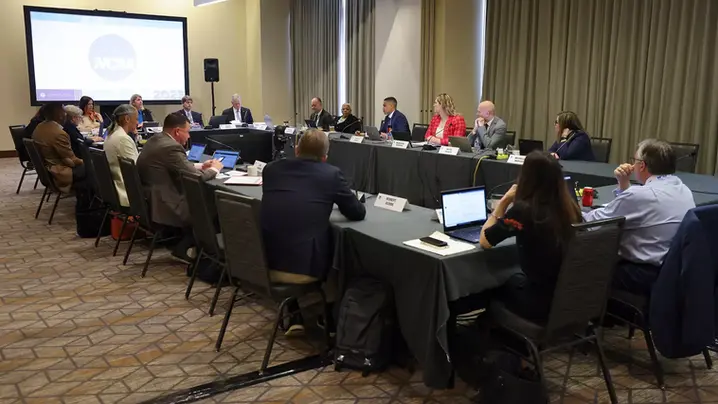
NCAA Board of Governors Discussing, Getty Images


CJ Stroud's Former NIL Agents, Getty Images
Action Network